
Becoming a child safe organisation
Being child safe is a continuous process that requires feedback and review.
Please note this information provides general guidance regarding the Child Safe Standards. It should not be considered as a substitute for legal advice.
Child abuse still happens now in organisations.
It is not just in the past.
“Thanks to recent inquiries and the advocacy of many survivors, we now know more than ever about the extent of harm done to children in organisational settings and this knowledge brings an obligation to act.”
Becoming a child safe organisation isn’t easy, but you can do it.
-
A child safe organisation puts children’s safety, wellbeing and rights at the centre of its decisions and everyday activities.
It builds a culture where children are listened to, concerns are taken seriously, and adults understand their responsibility to prevent and respond to harm. This includes safe recruitment, clear boundaries, accessible complaints processes, and safeguards for physical and online environments.
Being child safe is an ongoing commitment. Policies matter, but they must be understood, used and regularly reviewed.
-
Start with the National Principles for Child Safe Organisations and check the requirements that apply to your organisation, sector and location.
Practical first steps include:
Assigning clear responsibility for child safety to your leadership team and governing body.
Reviewing your activities to identify where children could experience harm, including online.
Listening to children, young people and families about what helps them feel safe.
Reviewing recruitment, screening, supervision and staff conduct.
Making sure everyone knows how to recognise, record and report concerns.
Creating an improvement plan with named responsibilities and deadlines.
Include cultural safety, accessibility and the needs of children who may face additional barriers to being heard.
-
The National Office for Child Safety provides a child safety and wellbeing policy template, along with resources to help organisations identify and manage risks. The Australian Human Rights Commission also provides practical tools to support the National Principles.
Your state or territory’s child safety authority and relevant sector regulator may provide additional templates and guidance.
Use templates as a starting point. Adapt them to your organisation’s activities, responsibilities, risks and legal requirements. Involve staff, volunteers, children and families where appropriate, and make sure your policies explain what people need to do in practice.
-
Requirements depend on where your organisation operates, the services it provides and the roles people perform.
You may need to meet requirements relating to Child Safe Standards, Working with Children Checks or equivalent screening, mandatory reporting, reportable conduct, and sector-specific regulation.
The National Principles provide a shared national framework, but they do not replace applicable laws or regulatory requirements. Organisations operating across jurisdictions should check their obligations in each location.
Check current advice from your state or territory child safety authority, screening body and sector regulator. Make sure your procedures identify who must report concerns, to whom and within what timeframe. Reporting internally does not replace any obligation to report externally.
-
Child safety learning should begin at induction and continue through refresher training, supervision and practical discussion.
Staff and volunteers should understand:
Children’s rights, cultural safety and inclusive practice.
Appropriate behaviour, professional boundaries and online safety.
How to recognise abuse, grooming and concerning behaviour.
How to respond calmly and supportively when a child raises a concern.
How to record and report concerns promptly.
Choose training relevant to your organisation’s activities and jurisdiction. Use realistic scenarios to check understanding, and make sure everyone knows where to find your policies and who to approach for help.
Training supports safer practice, alongside effective leadership, supervision and accountability.
-
Survivor perspectives can help organisations understand how harm occurs, why concerns may go unheard, and how institutional responses can either support recovery or cause further harm.
These insights can strengthen policies, complaints processes, staff training and organisational accountability.
Involving Survivors should be voluntary, respectful and supported. Explain how their input will be used, offer choices about participation and privacy, and recognise their expertise through appropriate payment. No one should be expected to disclose personal experiences to contribute.
Survivor perspectives should sit alongside the voices of children, young people and families, professional safeguarding expertise and applicable legal requirements.
Create a Child Safe Organisation
-

Create a Child Safe Taskforce
Collaboration is key! Identify potential contributors from your club: parents, admin staff, coaches, athletes, and those with relevant experience. Include children & young people for representation. Meet regularly, aiming for at least once every three months.
-

Do some readings
To begin your child-safe journey, you'll need some essential guidance. We recommend downloading and acquainting yourself with the 'Guide for Creating a Child Safe Organisation' provided by the Commission for Children and Young People. Read and ensure all task force members also have access to this guide.
-

See how you stack up
With the assistance of a task force and a improved comprehension of the standards, it is now the opportune moment to assess your club's performance. Conducting an audit is an excellent approach to achieve this. The audit will be instrumental in shaping your action plan and identifying the key areas of concern within your club. Keep in mind that this audit marks the initial step towards compliance, so there's no need to worry if you're not fully compliant right away. Most clubs encounter some work to be done during their first audit.
Additional Readings
Betrayal of Trust Report
The Victorian Government has created a factsheet outlining the new organisational duty of care to prevent child abuse.
CCYP Guide for creating a child safe organisation
This guide aims to support organisations to implement child safe practices to create a culture where the safety of children is promoted, child abuse is prevented, and allegations of child abuse will be taken seriously and acted on. It aims to help organisations comply with the Child Safe Standards (the Standards) under the Child Wellbeing and Safety Act 2005 (Vic).
e-learning modules
As part of the Child Safe Organisations project, the Australian Government commissioned the Australian Human Rights Commission to develop practical tools and resources to help organisations implement the National Principles for Child Safe Organisations.
Online safety posters
-
![An illustrated lizard sitting on the ground holding a phone, with text bubbles. One bubble says, 'I trust my feelings — I ask for help when something doesn't feel right.' The lizard is labeled as 'Dusty the frilled neck lizard.' At the bottom, tips include listening to body cues, closing the screen if something feels wrong, and asking a trusted adult for help. There are also cartoon images of Dusty's friends: River the sugar glider, Wanda the echidna, and Billie the bilby, with a note about their online safety messages from eSafety Australia.]()
Dusty the frill neck lizard
Dusty the frill neck lizard trusts his feelings
-
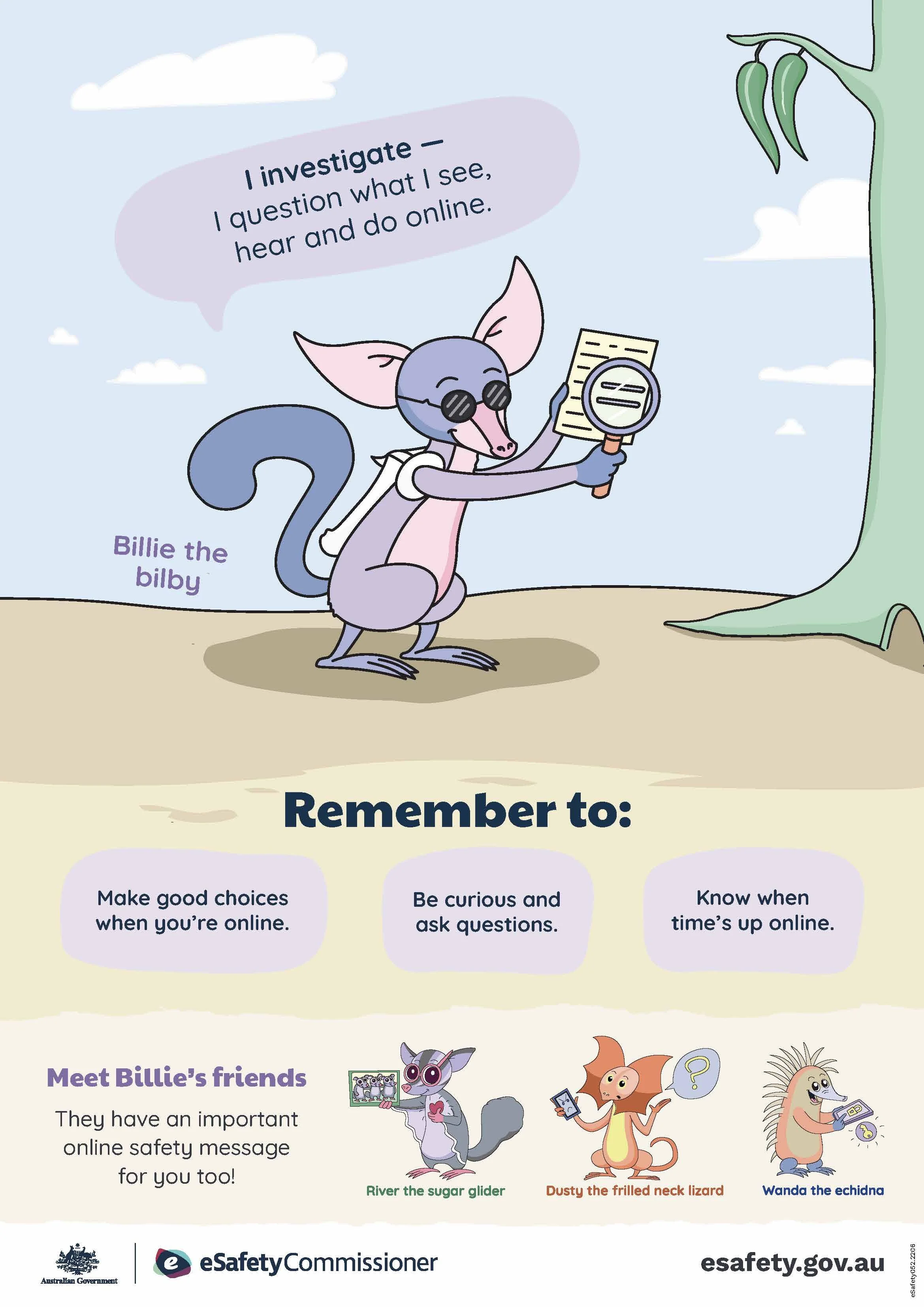
![Illustration of Billie the bilby dressed as a detective, holding a magnifying glass and a piece of paper, with a speech bubble saying "I investigate — I question what I see, hear and do online." The image includes safety tips about making good choices, asking questions, and knowing when time is up online. It also features three of Billie’s friends: River the sugar glider, Dusty the frilled neck lizard, and Wanda the echidna, each holding electronic devices. The image promotes online safety awareness.]()
Billie the Bilby
Billie the Bilby wants you to make good choices online
-
![A cartoon illustration of a sugar glider holding a photo with three sugar gliders in the background, wearing pink glasses and holding a heart. The scene includes a tree with leaves and clouds, emphasizing messages about respect, online safety, and sharing. The text encourages respectful online behavior, sharing with friends, and asking permission before sharing media. There are also cartoon characters representing friends: Billie the bilby, Dusty the frilled neck lizard, and Wanda the echidna, each holding a device.]()
River the sugar glider
River shows respect and is kind to others
-
![An illustration of Wanda the echidna holding a tablet, standing next to a tree and a cloud-filled sky, with safety tips below about protecting personal information, using apps appropriately for age, and device safety. Characters include River the sugar glider, Dusty the frilled neck lizard, and Billie the bilby, promoting online safety.]()
Wanda the echidna
Wanda is responsible and protects her personal information